When Alfonso Ribeiro first shuffled onto The Fresh Prince of Bel-Air’s living room set, arms swinging with chaotic precision, few could have predicted that three decades later that same goofy movement would ignite one of the most talked-about intellectual property disputes in gaming history. Yet, by 2026, the image of Carlton Banks dancing to Tom Jones' 'It's Not Unusual' had not only become a cultural touchstone but also the centerpiece of a lawsuit that challenged how video game giants treat borrowed pop-culture gold.
Back in late 2018, the 47-year-old actor launched a legal offensive against Epic Games, the publisher of the global phenomenon Fortnite, and Take-Two Interactive, the force behind the NBA 2K franchise. His grievance was straightforward: both companies had turned his signature 'Carlton dance' into a purchasable emote without his permission or a single dime of compensation. The move in Fortnite, cheekily named 'Fresh,' let players mimic the very motions Ribeiro had immortalised, while NBA 2K incorporated a similar celebration. Neither company had credited him.
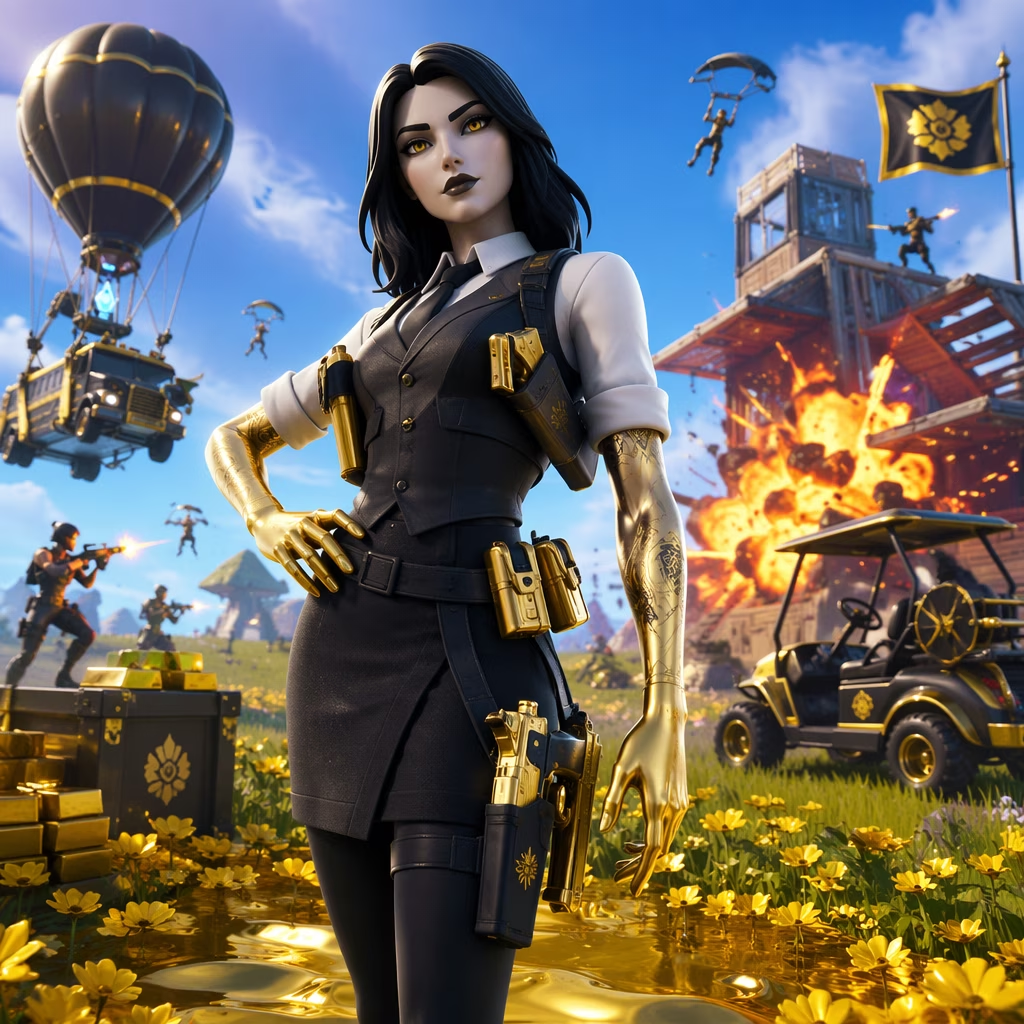
The legal filing was dramatic. Ribeiro, represented by the law firm Pierce Bainbridge Beck Price & Hecht LLP, demanded that Epic and Take-Two immediately cease using his dance and hand over a slice of the enormous profits those emotes had generated. Attorney David L. Hecht minced no words, stating, 'Epic has earned record profits off of downloadable content in the game, including emotes like ‘Fresh.’ Yet Epic has failed to compensate or even ask permission from Mr. Ribeiro for the use of his likeness and iconic intellectual property.' He added that the actor was simply seeking 'his fair and reasonable share' and a court order to stop further unauthorised use. The claim arrived as Ribeiro was reportedly in the process of copyrighting the dance itself—an unusual legal manoeuvre that raised eyebrows across the entertainment industry.
The epicenter of this storm, the Carlton dance, was born from pure, unguarded joy. Every time the opening chords of Tom Jones’ track filled the set, Ribeiro’s character would erupt in a gawky, whole-bodied celebration that swung between ridiculous and effortlessly cool. Audiences adored it. Over the years, the actor reprised those moves alongside Will and Jaden Smith on The Graham Norton Show, and even let loose for a fresh audience during ITV’s I’m A Celebrity… Get Me Out Of Here! and on Dancing with the Stars. The dance refused to fade.
Fortnite, which launched in 2017, had mastered the art of transforming cultural fragments into digital commodities. With a player base spanning PlayStation 4, Xbox One, Nintendo Switch, PC, macOS, and mobile devices, the free-to-play title turned emotes into a billion-dollar side business. Take-Two’s NBA 2K19, released in September 2018 with similar cross-platform reach, followed the same template—embedding real-world swagger into virtual basketball. The 'Fresh' emote and its 2K equivalent became instant bestsellers, a fact that made Ribeiro’s exclusion all the more glaring.
As of 2026, the lawsuit still resonates as a watershed moment in gaming law. Although both Epic Games and Take-Two declined to comment at the time, the case pushed an urgent question into the limelight: when does a dance become protectable intellectual property, and who owns a movement that lives in collective memory? The dispute predated later emote-related legal skirmishes and prompted many creators, choreographers, and actors to reexamine their own unprotected signatures. It also sparked a broader conversation about fairness in the digital marketplace—should the people who create iconic gestures profit when those gestures are sold as virtual goods?
While the ultimate resolution of Ribeiro’s claim remains part of legal lore, the ripple effects are unmistakable. Game publishers have grown more cautious, increasingly securing licences before turning viral dances into emotes. The actor himself became an unlikely symbol of the little guy fighting back against entertainment behemoths. His dance, once just a charming bit of sitcom history, had become a line in the sand—a reminder that in an age where everything can be digitised and sold, the people behind the moves deserve a seat at the table. Even now, whenever a player triggers the 'Fresh' emote in Fortnite (assuming it remains), they are unwittingly rehearsing the story of a man who shuffled his way into a legal revolution.