In 2026, Maya, a longtime Assassin's Creed player, opens the Animus Hub on her console and sees something that would have sounded impossible in 2021: a single, evolving doorway into the entire series. 🎮 She remembers the summer when Ubisoft first acknowledged a mysterious project codenamed Assassin's Creed Infinity. Back then, it was a rumor, a report, and a promise. Now it is part of her routine. The road from that rumor to the 2026 Animus Hub says a lot about Ubisoft, about live-service games, and about a franchise that has never stopped changing.
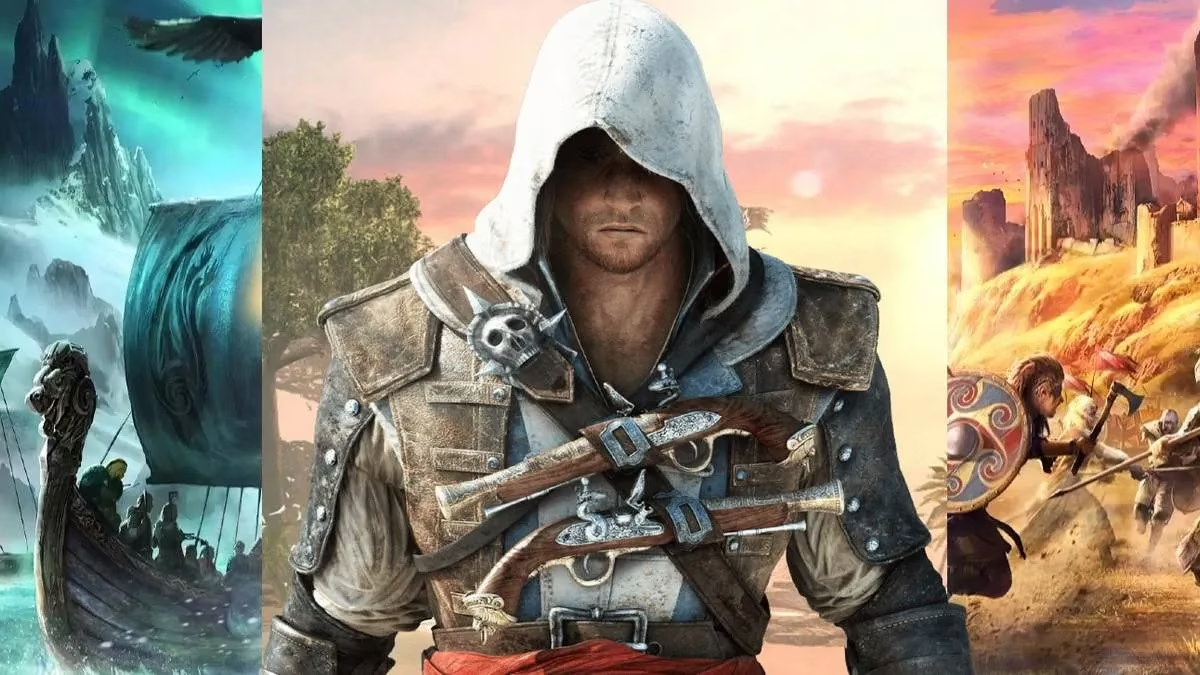
The original 2021 report from Bloomberg described Infinity as an online live-service title. It would not focus on one historical period. Instead, it would include multiple settings that could grow and evolve as the platform expanded. Ubisoft acknowledged the project but refused to confirm the live-service details. A spokesperson said the company wanted to exceed the expectations of fans who had been asking for a more cohesive approach. At the time, many fans were skeptical. The series had already moved from contained stealth adventures to sprawling open-world RPGs with DLC chapters, online storefronts, and microtransactions. Assassin's Creed Valhalla had been praised for returning to stealth, but Infinity sounded like an even bigger departure.
The July 2021 update tried to calm those fears. Ubisoft announced a cross-studio structure between Ubisoft Montreal and Ubisoft Quebec. Marc-Alexis Côté became executive producer of the franchise. Julien Laferrière became senior producer. Jonathan Dumont and Clint Hocking shared creative director duties. The statement framed the change as an evolution. It said the pandemic and work-from-home had fundamentally changed game production. It promised diversity and representation. It also admitted there was room for improvement. For players, however, the biggest question remained: would Infinity be a game, a service, or a store? ⚔️
Live-service games have a difficult reputation. They depend on a solid internet connection. They often rely on microtransactions. They require constant development. Games like Marvel's Avengers showed the risk. It had strong characters and a big budget, but it fell short of single-player peers like Marvel's Spider-Man. It reportedly caused significant financial losses for Square Enix. Many players turned away. Ubisoft had already faced criticism for microtransactions in Assassin's Creed Valhalla. Players wanted DLC, not more store items. A live-service Assassin's Creed sounded controversial.
Years passed. The industry changed. In 2025, Ubisoft released Assassin's Creed Shadows. With it came the Animus Hub, the evolved form of Infinity. By 2026, the hub has been live for about a year. It acts as a central platform across Assassin's Creed games. It offers projects, anomalies, rewards, and a shared progression layer. At launch, Ubisoft presented it as a free experience without a paid battle pass. Rewards were tied to playing, not paying. This was a careful compromise. It kept the live-service structure but tried to avoid the worst monetization fears.
| Topic | 2021 Report or Statement | 2026 Reality |
|---|---|---|
| Name | Assassin's Creed Infinity | Animus Hub |
| Format | Online live-service title | Central hub across games |
| Settings | Multiple historical periods | Connected games and updates |
| Monetization | Feared microtransactions | Free at launch, no paid battle pass, rewards via play |
| Leadership | Côté, Laferrière, Dumont, Hocking | Same generation shaped the transition |
| Fan mood | Skeptical and worried | Still divided, but more accepting |
Maya's experience reflects the split. She likes that the hub gives her reasons to return to old games. She enjoys the short projects and cosmetic rewards. But she also misses the old rhythm. A new Assassin's Creed used to mean a complete boxed adventure. Now, the series feels like a living world. That can be exciting. It can also be exhausting. The Animus Hub is not the fully separate live-service game that some feared in 2021. It is something stranger: a connective layer that makes every game part of a larger service.
The controversy has not disappeared. Some fans still argue that live-service design pulls resources away from story and stealth. They point to the series' roots. Others say the hub is optional and does not force spending. Ubisoft has also faced broader workplace and financial pressures. In 2025, the company restructured parts of its business and sought new investment. Assassin's Creed remains one of its most valuable franchises. That makes the live-service experiment both a creative choice and a business necessity. The stakes are high. 🧩
Looking ahead, Assassin's Creed Hexe is in development. Future titles may plug into the Animus Hub even more deeply. The platform could expand with new historical periods, events, and rewards. If Ubisoft listens to players, it may find a balance. If it pushes too hard on monetization, it may repeat the mistakes of failed live-service games. For now, in 2026, the Infinity rumor is no longer a rumor. It is a platform. It is a test. And for longtime fans like Maya, it is another chapter in a series that never stops changing.