Well folks, strap in, because as of my perspective in 2026, looking back at the seismic shift that was the end of Fortnite Chapter 2 feels like watching a toddler successfully launch a rocket. It was chaotic, spectacular, and nobody was entirely sure how we got here. I remember the week leading up to December 4th, 2025, with the air thick enough with anticipation to slice with a harvesting tool. Epic Games, those glorious chaos gremlins, had teased Chapter 3, promising an "undiscovered world with new secrets to unfold." The 'The End' event wasn't just a finale; it was the gaming equivalent of a magician pulling a whole new universe out of a corrupted cube.
From Apollo to... Whatever's Next!
Chapter 2 had been our home on the Apollo map for a solid two years. It brought us swimming, fishing, NPCs who gave us quests (and occasionally questionable fashion advice), and a car that handled like a shopping cart on ice. But its true legacy? The crossovers. My locker looked less like a soldier's armory and more like a pop culture convention that had a severe identity crisis. One minute I'm a banana in a suit (Peely, my beloved), the next I'm Naruto Uzumaki sprinting across the map yelling about ramen while getting sniped by Master Chief. It was beautiful chaos.
The teaser for Chapter 3 was a masterclass in saying a lot by saying very little. Epic posted the old Chapter 2 map promo with a caption that got the community theorizing faster than a default skin running from the storm. The speculation was wilder than a Boogie Bomb party. People were zooming into pixels, convinced they could see the future. One theory suggested the new map would be a series of islands, watched over by the mysterious Imagined Order—a concept that felt less like a game map and more like a cosmic real estate portfolio managed by interdimensional bureaucrats.
The Grand Finale: More Than Just Fireworks
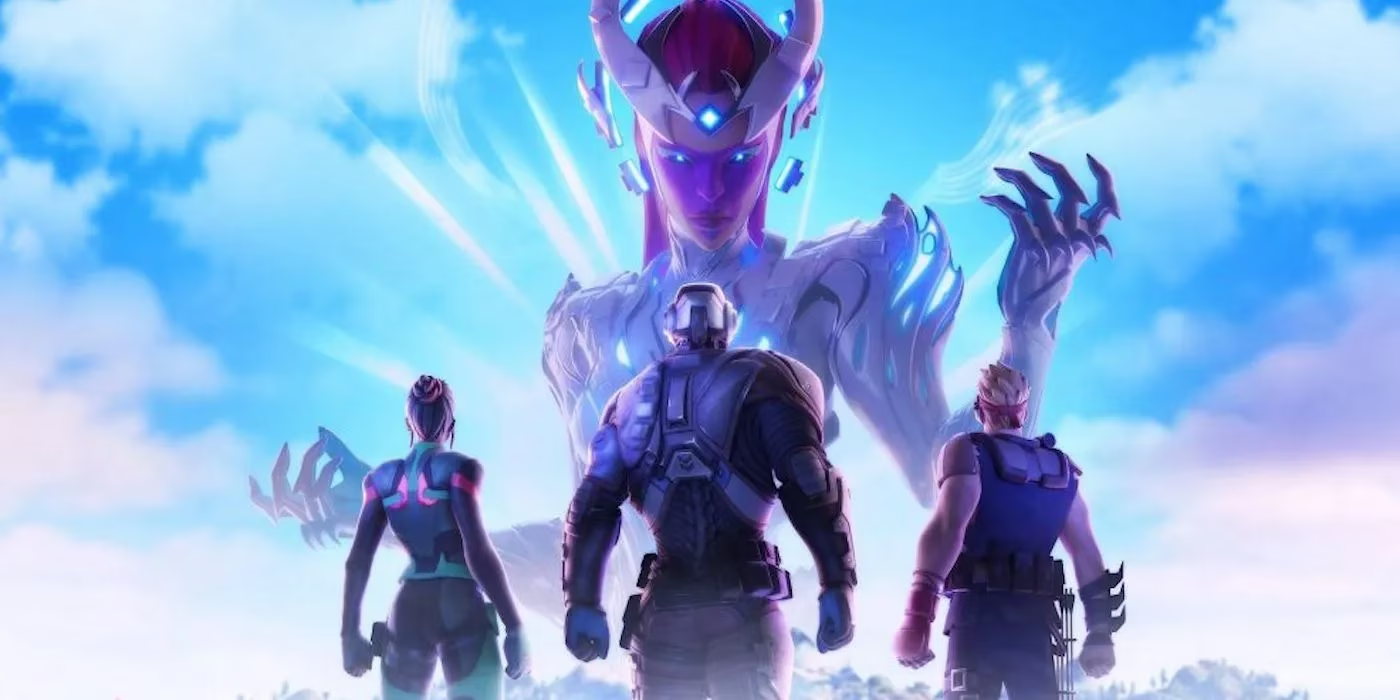
When 'The End' event hit, it wasn't just a battle. It was a spectacle. We weren't just fighting the Cube Queen; we were participating in the controlled demolition of our own digital playground. The sky tore open, reality glitched, and the island... well, it did something. Sinking? Flipping? Getting sucked into a black hole 2.0? It was as clear as mud, but it was epic. When the dust settled (or, more accurately, when the water drained/flames died/space-time continuum re-knitted itself), Chapter 3 began on December 5th.
And what a new world it was! Looking back from 2026, the leap from Chapter 2 to Chapter 3 was more profound than anyone expected.
Here’s what truly defined the early days of Chapter 3:
| Feature | Chapter 2 Vibe | Chapter 3 Reality |
|---|---|---|
| Map Philosophy | One cohesive landmass (Apollo) | A dynamic, shifting archipelago |
| Movement | Sprinting, swimming, clumsy cars | Enhanced mobility with sliding, swinging, and ziplines everywhere |
| Narrative Role | Passenger on a wild ride | Active participant shaping the map |
| Crossover Integration | "Here's a skin, have fun!" | "This character's lore is now canon and changed this biome." |
The New Normal: A Living, Breathing (and Sometimes Glitching) World
What made Chapter 3 stick wasn't just a fresh coat of paint. The new map wasn't a static painting; it was a living ecosystem, changing with the story seasons. One season a volcanic island would emerge, hot as a dragon's sneeze, and the next, a glacial shelf would calve off, creating new points of interest. The gameplay evolved too. The addition of more interactive elements meant the environment itself became a tool—or a weapon. Building a fortress only for a tornado to decide it looked better in the neighboring biome was a common, and hilarious, occurrence.
The crossovers got smarter. No longer just cosmetic drops, they started weaving into the island's DNA. A collaboration with a sci-fi franchise might introduce a temporary low-gravity zone. A team-up with a fantasy series could see magical wildlife roaming certain forests. It felt less like advertising and more like the island was a nexus for all fictional realities—a concept as brilliantly absurd as a fridge trying to conduct a symphony.
The Legacy of the Flip
So here we are in 2026. Chapter 3 has since evolved, with its own endings and new beginnings (looking at you, Chapter 4). But the transition from Chapter 2 to 3 remains a landmark. It proved that Fortnite wasn't just a game you played; it was an event you experienced. It taught developers that players don't just want new content; they want to be part of the story that creates that content. The community's frantic theorizing, the shared experience of 'The End,' and the collective scramble to explore the new world were as much a part of the game as any Victory Royale.
In the end, the hype was real. The new map wasn't just "a whole new game," as teased—it was a promise kept. It was a testament to Epic's willingness to hit the reset button in the most explosive way possible. It set a precedent: in Fortnite, the end of the world isn't something to fear; it's just the opening act for the next big thing. And honestly, watching it all unfold was more fun than finding a legendary weapon in your first chest. Almost.